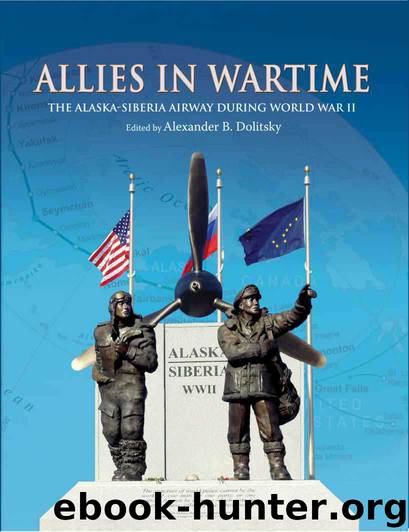
Allies in Wartime: The Alaska-Siberia Airway During World War II by Dolitsky Alexander
Author:Dolitsky, Alexander [Dolitsky, Alexander]
Language: eng
Format: epub
Publisher: Alaska-Siberia Research Center
Published: 2012-03-07T16:00:00+00:00
Soviet and American pilots at Ladd Field, Fairbanks, 1944. Courtesy of Ivan Negenblya.
The Aircraft over the Tundra and Taiga
Bombers and transport airplanes were usually flown one at a time or in groups of two or three. Fighters, as a rule, were flown in wedge-shaped groups, headed by a bomber leader close ahead. A bomber or fighter squadron leader would bring up the rear.
Because the fighters had a limited range, the entire 6,575-kilometer [4,086 miles] route from Fairbanks to Krasnoyarsk was divided into five stages. Each stage had its own Ferry Aviation Regiment that operated only within its own stage. After passing the planes to their destination at the neighboring regiment, the pilots returned to their base by transport aircraft flown by a special squadron, the 8th Transport Aviation Detachment, formed on July 4, 1943, and commanded by Lieutenant-Colonel V.A. Pushchinsky.
The delivery of the aircraft was performed as follows: American pilots ferried the airplanes from aircraft factories in the U.S., across Canada, to Fairbanks, where the Soviet Military Mission representatives received them. In Fairbanks, the planes were taken by the 1st FAR pilots (commanded by Lieutenant-Colonel P. Nedosekin, and later Lieutenant-Colonel N.S. Vasin), and flown to Nome, Alaska, and then across the Bering Strait to Uelkal, the airport on the coast of the Anadyrsky Gulf, Chukotka. This stage of the route was 1,560 kilometers long [970 miles]. These flights were hindered by prolonged and constant fog from the sea, thunderstorms over Alaska, and severe winter frosts and snowstorms. On the Bering Strait crossing to the Uelkal stage, there were fewer flying days a year than in any stage along the whole route. Because of Alaska's extreme weather conditions, during 1944 on the Fairbanks-Nome stage there were only 109 flying days, compared to 181 flying days on the Yakutsk-Kirensk stage.
The 2nd Ferry Aviation Regiment, commanded by Lieutenant-Colonel A.G. Melnikov and later Lieutenant-Colonel M.I. Pavlenkov, was stationed in Uelkal. The 2nd FAR was responsible for aircraft delivery via the most difficult 1,450-km [902 miles] stage from Uelkal over the uninhabited Chukotka, the Kolymsky Ridge, and on to Seymchan.
The 3rd stage, 1,200 km [745 miles] from Seymchan to Yakutsk, was also not easy; it went over the Chersky and Verkhoyansk Ridges through the Oymyokon region. Quite often pilots had to fly at high altitude at very low temperatures, wearing oxygen masks. From Seymchan, aviators from the 3rd Ferry Aviation Regiment, commanded by Lieutenant-Colonel N. Tverdokhlebov and later by Major V.I. Frolov, piloted the airplanes to Oymyakon, Khandyga and then to Yakutsk. Oymyakon earned its nickname, the "Pole of Cold." In the winter of 1944, temperatures registered at -50° C on 69 days. In Yakutsk, 21 days dipped to that same low temperature. 19 Thick fogs accompanied the heavy frosts. Therefore, from the 2nd half of November until mid February, the delivery of aircraft was carried out mainly along the Okhotsky seacoast route, via Magadan to Kirensk, and then onto the main route.
Download
This site does not store any files on its server. We only index and link to content provided by other sites. Please contact the content providers to delete copyright contents if any and email us, we'll remove relevant links or contents immediately.
| Africa | Americas |
| Arctic & Antarctica | Asia |
| Australia & Oceania | Europe |
| Middle East | Russia |
| United States | World |
| Ancient Civilizations | Military |
| Historical Study & Educational Resources |
The Radium Girls by Kate Moore(12036)
100 Deadly Skills by Clint Emerson(4932)
Rise and Kill First by Ronen Bergman(4797)
The Templars by Dan Jones(4695)
The Doomsday Machine by Daniel Ellsberg(4493)
The Rape of Nanking by Iris Chang(4224)
Killing England by Bill O'Reilly(4008)
Stalin by Stephen Kotkin(3973)
Hitler in Los Angeles by Steven J. Ross(3949)
12 Strong by Doug Stanton(3554)
Hitler's Monsters by Eric Kurlander(3352)
Blood and Sand by Alex Von Tunzelmann(3207)
The Code Book by Simon Singh(3197)
Darkest Hour by Anthony McCarten(3137)
The Art of War Visualized by Jessica Hagy(3014)
Hitler's Flying Saucers: A Guide to German Flying Discs of the Second World War by Stevens Henry(2759)
Babylon's Ark by Lawrence Anthony(2686)
The Second World Wars by Victor Davis Hanson(2529)
Tobruk by Peter Fitzsimons(2521)
